Chimera TCG
- 4.4
- Rating
- 10.00K
- Installs
- Free
- Price

 Analysis by App-foxy
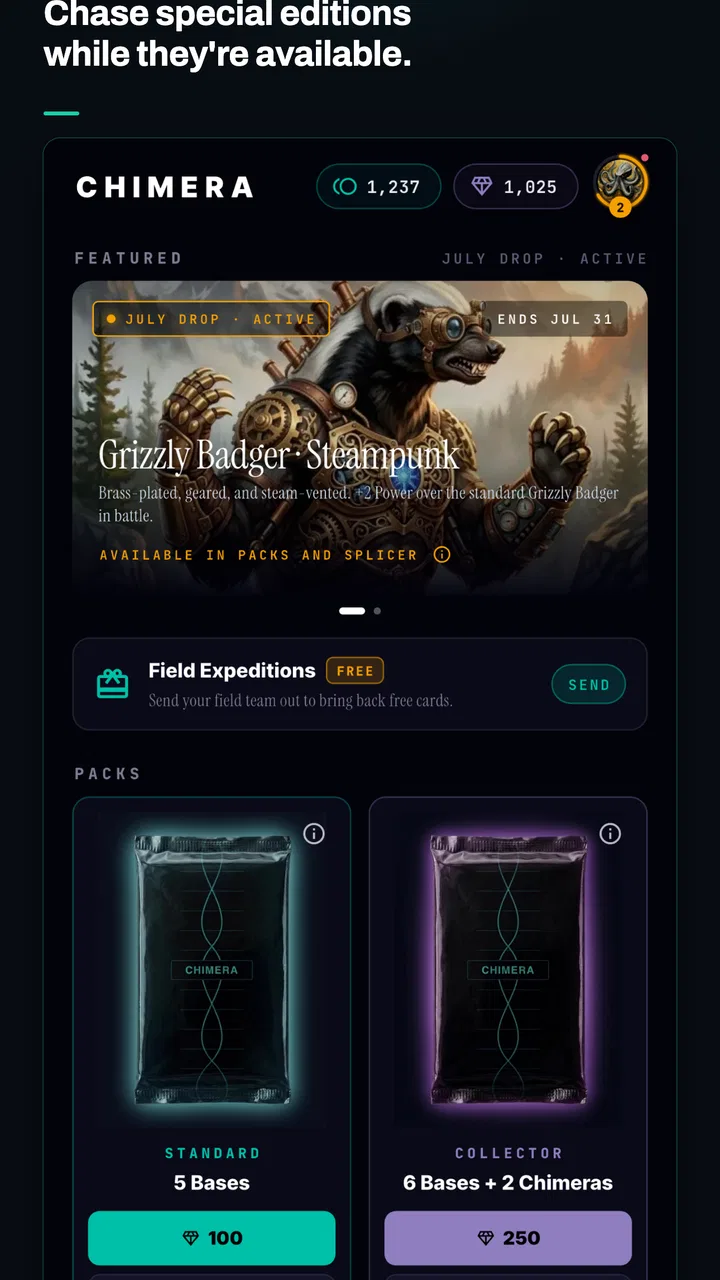
I went into Chimera TCG expecting a quick card game built around an amusing creature-mixing idea, and that first impression is exactly where its appeal is strongest. The game, developed by Bauman Games, lets me combine real animals into unusual creatures and then use those creations in battles. It is a simple concept to understand, but it gives the opening sessions a useful sense of discovery: every new combination feels like both a collection goal and a possible tactical experiment.
What makes the game stand out is not just the creature theme. It places the collecting fantasy inside a trading card game format, so I am not merely filling a gallery with strange animals. I am also thinking about which cards belong together, what kind of battle plan a creature supports, and whether a new addition is genuinely useful or simply entertaining to look at. That balance between curiosity and decision-making is the main reason I kept returning during the first week.
The first sessions are easy to understand, but not empty
The free entry point helps a lot. I can try the central loop without first deciding whether the game deserves a purchase, and the Everyone age rating makes it approachable for a broad audience. The store summary is brief, but in practice the idea is clear enough to pull me into experimentation quickly: collect animal-based cards, splice them into unfamiliar forms, and take those creations into combat.
You May Also Like

 AccuWeather: Weather Radar
AccuWeather Review: A Quick, Clear Forecast for Everyday Decisions
For everyday plans, the best forecast is the one you can understand quickly. AccuWeather makes rain timing, radar, and local conditions easy to act on, with a few trade-offs.

 Hill Climb Racing
Why Hill Climb Racing Still Turns Crashes Into One More Run
A tiny car, a bumpy hill and one more upgrade: Hill Climb Racing keeps resurfacing because its simple chaos makes every near-miss feel personal.

 AliExpress - Shopping App
AliExpress Makes Global Shopping Feel Personal, but Shoppers Bear the Risk
AliExpress turns a global marketplace into a pocket-sized discovery engine. Its reach is useful, its shopping loop compelling, and its trade-offs easy to miss.

 Lords Mobile: Kingdom Wars
Lords Mobile Is a Kingdom-Building Routine, Not a Quick Match
A case-by-case verdict on the building, battles, device demands, and social commitments that make Lords Mobile rewarding for some players and exhausting for others.

 PDF Scanner app - TapScanner
TapScanner Makes Paperwork Easier to Capture, Check, and Share
TapScanner makes scanning with a phone feel less like a rescue operation and more like a dependable step in getting work done. Its capture tools are useful, though not flawless.

 Block Blast!
 Shows How Much a Puzzle Game Can Leave Out
A quiet grid game shows why puzzle players increasingly value instant clarity, repeatable skill and low-pressure play—and where the genre still needs to catch up.
More From Our News Desk
View All News


I especially liked how the theme gives ordinary card collecting a more personal feel. In a traditional card game, a new card may be valuable because of its effect or rarity. Here, I also want to see what sort of creature it can help produce. That visual and imaginative layer makes the early collection feel less like sorting numbers and more like building a small bestiary with a competitive purpose.
For a casual player, this creates a comfortable first-week rhythm. A short session can focus on trying a new combination, while a longer session can revolve around battles and adjustments. I would recommend starting by testing combinations for their practical role rather than chasing the most bizarre result immediately. The unusual creatures are the hook, but learning which ones actually fit my preferred approach is what gives the battles more meaning.
Why the novelty works at the beginning
The strongest early loop comes from the question, “What happens if I combine these?” That question is more effective than a standard unlock screen because it encourages active participation. I am not simply waiting for a reward animation; I am making a choice and then seeing whether the result is useful. Even when a combination does not perform as hoped, it can teach me something about how I want to build my collection.
There is also a nice tension between collecting for fun and collecting for performance. Someone can enjoy the creature designs without caring deeply about competitive optimization, while a more analytical player can treat each new card as part of a larger battle puzzle. That gives the game a wider audience than a purely cosmetic collection app would have.
My practical advice for the opening period is to avoid changing everything after every disappointing battle. Keep a small core of cards or creatures that already feel dependable, then change one part of the setup at a time. This makes it easier to understand whether a new combination helped, rather than leaving me unsure which change caused the result.
Does the collection stay interesting after the first month?
I find the first-month question is less about how many creatures I can collect and more about whether I can keep finding fresh reasons to use them. A simple habit helps: save one dependable battle setup, then change just one creature or pairing when I experiment. That makes the collection feel like a set of choices rather than a checklist, and it gives each return visit a small, clear purpose.
The real test is whether experimentation becomes a habit
The first-week appeal is obvious, but a card game needs more than a clever premise to earn a permanent place on a phone. After the novelty of seeing strange animal combinations begins to fade, the recurring value depends on whether I still have meaningful reasons to revisit my collection and battles. In my experience, the game is most satisfying when I treat it as a small strategy hobby rather than as a game I must play continuously.
That distinction matters. I would not choose it as my only mobile game if I wanted a deep, constantly changing competitive ecosystem. Its strongest long-term role is as a compact card game I can return to, experiment with, and put down without feeling that I have missed an entire evening. The creature-building premise gives each return visit a clear starting point, but the battles need to remain interesting enough to justify the preparation.
A useful monthly routine is to review the collection before immediately entering another fight. I can look for combinations I have ignored, separate cards that are fun from cards that support a consistent plan, and then run a few focused tests. This approach turns the collection into a workshop. It also reduces the common card-game problem of playing the same comfortable setup until every match feels identical.
Who gets the most lasting value
I think the best audience is someone who enjoys collecting, likes unusual creature concepts, and wants battles with a layer of personal experimentation. It is also a good fit for players who prefer a free game they can sample at their own pace instead of committing to a premium purchase immediately.
It may be less suitable for someone seeking a highly elaborate card game with extensive deck theory, a large social scene, or a competitive structure that dominates every session. Players who dislike trying combinations that may not work will probably lose interest sooner, because the central pleasure comes from testing ideas rather than receiving a guaranteed perfect result every time.
It is also worth being realistic about the free-to-play model. The game is free, but optional in-app purchases range from $0.99 to $99.99 per item. That wide range means I would approach spending carefully. I would first decide whether the basic loop is enjoyable without purchases, then set a personal limit before browsing optional offers. For a collection-focused game, impulse spending can easily replace the satisfaction of gradually learning the system.
A realistic everyday use case
Chimera TCG works well for a player who has a few spare moments during a commute, a lunch break, or the quiet part of an evening. I might open it with one specific goal: test a creature combination, tune a battle setup, or use a newly collected card. That is better than opening the game without a plan and repeating the same actions until the session becomes automatic.
For example, after a busy day I could spend a short session examining a creature that looked interesting but performed poorly earlier. Instead of discarding it, I would pair it with a different selection, play a few battles, and decide whether its weakness came from the creature itself or from the surrounding setup. That kind of small experiment gives the session a beginning, middle, and conclusion, even if I do not play for long.
The game is less convincing when I expect it to supply endless entertainment on demand. Its recurring value comes from having a question to investigate. If I have no interest in collection goals or tactical testing, the unusual animal theme alone may not carry the experience for very long.
How it compares with familiar card-game alternatives
Compared with a conventional digital card battler, this game has a more playful identity. The creature-splicing idea gives me a reason to care about the collection beyond abstract card strength. It feels closer to combining a creature-collection hobby with battle preparation than to simply reproducing a tabletop deck game on a phone.
That focus is also its trade-off. Players who want highly formal deck construction may find the animal concept more appealing than the surrounding depth. On the other hand, people who find traditional card games intimidating may appreciate having a concrete visual idea to guide experimentation. I can begin with curiosity, then gradually become more deliberate about battle choices.
Compared with a purely casual matching or collecting game, Chimera TCG asks more from me. I need to remember what I have tested, notice which combinations fit together, and accept that a visually exciting creature may not be the most effective choice. That extra friction is valuable for players who want decisions, but it makes the game less relaxing than a card app designed only for quick, low-stakes interaction.
The maintenance burden is modest, but it is still real
The main maintenance task is mental rather than technical: keeping track of what I have tried and resisting the urge to rebuild everything constantly. A collection can become messy when every new card inspires a completely different setup. I get better results by maintaining a dependable base and a separate experimental group.
This two-part approach is one of the most useful habits I found. The dependable group gives me a way to enjoy battles without starting from zero, while the experimental group keeps the collection fresh. It also protects the game from one of its biggest long-term problems: if every session requires a full rebuild, the preparation can become more tiring than the battle.
I would also avoid treating every new unlock as an automatic upgrade. A card can be interesting without belonging in the setup I currently use. Testing it in isolation, then testing it alongside one familiar choice, gives me a clearer sense of its role. This is a small workflow, but it helps preserve the feeling that I am making decisions rather than simply replacing older cards whenever something new appears.
Where fatigue can begin
The novelty can wear down if the creature combinations stop feeling connected to meaningful battle choices. If I am only collecting unusual designs without discovering new ways to use them, the loop becomes repetitive. The same thing happens if battles encourage me to rely on one safe setup and offer little reason to explore alternatives.
There is another kind of fatigue that comes from collection pressure. The free-to-play structure, together with optional purchases, can make a player feel that progress should be accelerated. I prefer to treat purchases as optional support rather than as part of the normal rhythm. If I start measuring enjoyment by how quickly I can obtain the next item, the creative side of the game becomes less important.
The version listed for the game is 1.23.28, and it runs on Android 7.0 or later. That makes it accessible to a fairly broad range of Android devices, though the experience will still depend on the phone itself and on how comfortable the interface feels during collection management and battles. I would give the game a little time on an older device before deciding whether it belongs in my regular rotation.
What the audience response suggests
The game currently holds a 4.4 average from around 271 ratings, with roughly 93 written reviews, and has passed 10K+ installs. Those figures suggest a small but clearly interested audience rather than a massive mainstream presence. I read that as a reason to approach it on its own terms: its appeal is specific, and the unusual premise will matter more to the right player than broad popularity would.
For me, the positive signal is understandable. The concept is immediately recognizable, the free price lowers the risk of trying it, and the combination of collection with battles gives the animal theme something to do. The caution is equally clear: a small card game has to rely heavily on the quality of its central loop, so anyone who needs constant variety should judge the experience by several sessions rather than by the first amusing combinations.
My long-term verdict
Chimera TCG earns lasting space when I use it as an experiment-driven card hobby, not as an endlessly demanding daily obligation. The animal-splicing idea is distinctive enough to make the opening sessions memorable, and the battle layer gives the collection a practical purpose. I like that a new creature can be both a fun discovery and a reason to rethink how I approach a match.
Its long-term weakness is that the same premise can become routine if I stop testing new ideas. The maintenance burden is manageable, but I need a small amount of self-discipline: keep a reliable setup, experiment in controlled steps, and avoid letting purchase pressure dictate the pace. Players who enjoy that rhythm will find more value here than someone looking for a huge, constantly evolving card platform.
I would recommend giving it a try if you like creature collecting, light strategy, and the satisfaction of making a strange combination work. I would skip it if your priority is a deeply competitive card game with extensive formal systems or if you prefer games that remain entertaining without any collection management. For the right player, the novelty does not have to disappear completely; it can mature into a repeatable habit built around testing, refining, and discovering which impossible-looking creatures are actually worth taking into battle.
FAQs for Chimera TCG
01What is Chimera TCG and how does the game work?
Chimera TCG is a digital trading card game focused on collecting cards, building competitive decks, and battling other players. Matches generally require you to combine creatures, abilities, and tactical effects effectively rather than relying only on card rarity. Before downloading, keep in mind that the experience may include tutorials, deck-building systems, progression mechanics, and online features that are best enjoyed with a stable internet connection.
02Is Chimera TCG free to download and play?
Chimera TCG can be downloaded and played without an upfront purchase, although free-to-play games commonly include optional in-app purchases. These may provide card packs, cosmetic items, progression boosts, or other digital content. You should review the store listing and the game’s purchase settings before starting, especially if children will use the device. It is possible to enjoy the core experience for free, but collecting cards may take longer without spending money.
03Does Chimera TCG require an internet connection?
Because Chimera TCG is designed around digital card collection, account progression, and player-versus-player features, an internet connection is likely required for important parts of the game. Online access may be needed to synchronize your collection, participate in matches, claim rewards, and receive updates. Offline access may be limited or unavailable, so the game is better suited to players who normally have reliable Wi-Fi or mobile data.
04Is Chimera TCG suitable for beginners?
Chimera TCG can be approachable for newcomers, particularly if its tutorial and introductory battles explain the card types, turn structure, and deck-building rules clearly. However, collectible card games often become more complex as you face experienced opponents and encounter larger card pools. New players should expect to spend time learning interactions, testing different strategies, and improving their decks rather than winning every match immediately.
05What should I check before downloading Chimera TCG on Android or iOS?
Before installing Chimera TCG, check that your phone or tablet meets the supported operating-system and hardware requirements, and make sure enough storage is available for the initial download and future updates. You should also review the game’s age rating, privacy policy, online-interaction information, and in-app purchase details. Availability, features, and performance can vary between Android and iOS devices, so reading the current store description is recommended.
Pros
- Strategic card battles offer depth for both casual and competitive players.
- Distinct card abilities encourage experimentation with different deck styles.
- Matches are engaging without requiring long play sessions.
- Regular events can add variety and give active players new goals.
- The fantasy-themed presentation makes the game easy to get into.
Cons
- Learning card interactions may feel overwhelming for new players.
- Progress can become slower without consistent daily play.
- Competitive balance may change after updates or new card releases.
- Online play depends on a stable internet connection.
- The card pool may feel limited until future content updates arrive.

Chimera TCG
Gallery